Forces
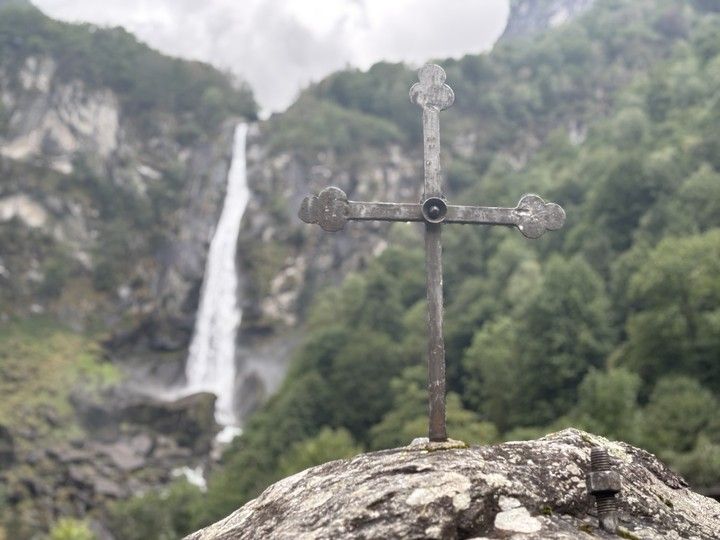
A metal cross on a rock in front of the waterfall in Foroglio.
It looks small against the force behind it.
Maybe that is why symbols like this feel so at home in the mountains. They remind us that not everything is in our hands.
But that thought becomes more difficult to hold when some of the forces around us are no longer entirely independent of our actions.
In August 2026, a collapse high in the Himalayas near the Nepal-China border sent ice, rock, water and debris almost 100 kilometres downstream. Hundreds of people were killed, many more are still missing. Scientists are still reconstructing exactly what happened, and it would be too simple to attribute one catastrophe directly to climate change. But the wider direction is less ambiguous: warming glaciers and thawing permafrost are making high mountain regions less stable.1
We do not have to look as far as Nepal.
In May 2025, most of Blatten in the Swiss Lötschental was buried after rock fell onto the Birchgletscher and a large part of the glacier subsequently collapsed. The village had been evacuated days earlier. One person still lost his life.2 The individual event had its own geology and sequence of causes. But Switzerland expects climate change to increase risks from unstable slopes, landslides, debris flows and rockfall in mountain regions.3
Mountains have always reminded us that there are forces bigger than us.
For centuries, what followed from those forces could be called nature, fate, perhaps even an act of God.
But climate change blurs that line.
The mountain may still fall on its own terms. The question is whether we can still think of ourselves as mere bystanders when we are changing the conditions that make such collapses more likely.
What can we still call fate when we have become part of the cause?
-
The U.S. Geological Survey describes the initial scientific reconstruction in 2026 Nepal Debris Avalanche and Flash Flood. It reports that the 26 August 2026 event was likely triggered by a glacial collapse near Langtang Lirung and that the resulting debris flow and flooding travelled nearly 100 kilometres. Reuters reports hundreds of deaths and nearly 1,000 people missing in Hundreds killed and more than 1,000 missing after Himalayan flood. Nature examines the wider relationship between warming, melting glaciers, thawing permafrost and high-altitude instability in Glacier collapse caused Nepal’s deadly flash flood — a sign of things to come?. Scientists caution that the contribution of climate change to this specific collapse has not yet been established.
-
Büntgen, Ulf, et al. reconstruct the Blatten disaster in The 2025 Blatten disaster in the Swiss Alps followed exceptional warming and highlights the vulnerability of people and heritage in glaciated landscapes, published in Communications Earth & Environment in 2025. The study reports that most of Blatten was buried by the 28 May rock-ice avalanche, that the population had been evacuated nine days earlier following surveillance and hazard assessment, and that a shepherd who had returned to an area outside the evacuation zone was the sole fatality.
-
MeteoSwiss describes the effects and expected risks of warming in Climate change. It identifies Swiss mountain regions as particularly vulnerable to deteriorating slope stability and increased landslides, debris flows and rockfalls, while noting that Switzerland is warming considerably faster than the global average.