Preference ≠ Artistic Value
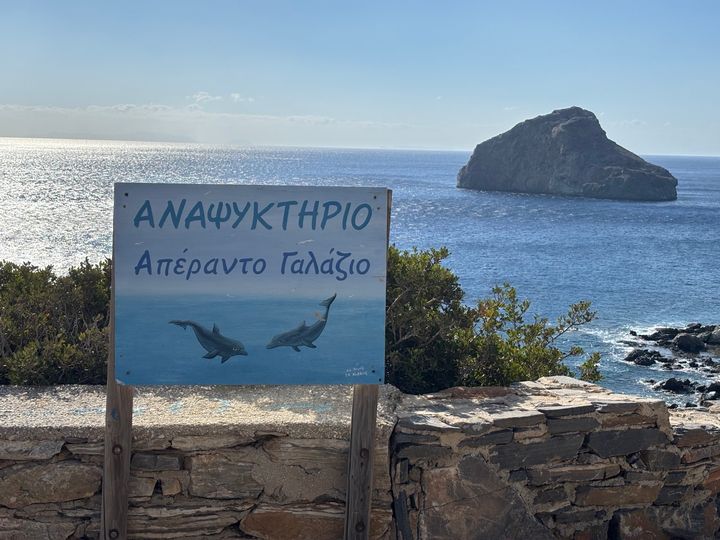
I took this photograph near Agia Anna on Amorgos, where scenes from Luc Besson’s The Big Blue were filmed.1 The hand-painted sign carries the film’s Greek title, Απέραντο Γαλάζιο.2
Spoiler warning: This gives away the ending of a 38-year-old film. Twice.
The film follows Jacques and Enzo, childhood friends who grow into rival freedivers, and Johana, who falls in love with Jacques as his pull toward the sea becomes increasingly consuming.
In Besson’s intended ending, Jacques descends one last time. He lets go and swims into the darkness with a dolphin. We never see him return.
For the American release, the ending was changed. Jacques still swims away with the dolphin. But this time, he comes back to the surface.3
Same story. Different endings. Very different meaning.
This was not Besson offering two artistic alternatives. For the U.S. release, the film was recut and Éric Serra’s score was replaced by one from Bill Conti.4 Besson later said producer Jerry Weintraub had tried to turn it into “Rambo Under the Sea.”5
In 1988, this meant adapting one work for one market.
Today, we are much better at adapting media for one person. I was already writing about individual targeting in 2010: the idea that what we watch or consume could be tailored to us individually.
Netflix now predicts which films we are most likely to enjoy.6 Spotify has started talking about “individual media”: content generated for an audience of one.7 Generative video can already create scenes from text or images.8
The more consequential step would be not only personalizing which work we see, but the work itself.
My ending. My pacing. My soundtrack. Perhaps even my story.
The two versions of The Big Blue make the tension concrete: changing the ending changes more than what happens. It changes what the film means.
Some of the value of art lies in what we would not choose: ambiguity, discomfort, slowness, sadness, an ending we dislike. Sometimes the artist’s decision to deny us what we want is the point.
Personalization can make media more relevant, accessible and enjoyable. But if preference becomes the measure, the parts we would rather remove may be the parts that matter.
What if audience preference and artistic value are sometimes negatively correlated?
-
Amorgos.gr, Agia Anna beach, 11 May 2018 – connects Agia Anna with scenes from The Big Blue.
-
Hellenic Film Commission, Απέραντο Γαλάζιο – identifies the film’s Greek title and lists Amorgos among its filming locations.
-
Muck47, The Big Blue (Comparison: Original Theatrical Cut - Director’s Cut), Movie-Censorship.com, 27 December 2025 – compares the original ending with the added U.S. surfaced ending.
-
Kevin Thomas, “MOVIE REVIEW : ‘The Big Blue’ Sinks Deep Into Pointlessness”, Los Angeles Times, 19 August 1988 – reports the recut U.S. release and Bill Conti score.
-
Susan King, “The ‘Fairy Tale’ Luck of Director Luc Besson”, Los Angeles Times, 27 March 1991 – quotes Besson describing the U.S. handling as an attempt to make the film “Rambo Under the Sea.”
-
Netflix, How Netflix’s Recommendations System Works – explains how Netflix estimates which titles a member is likely to enjoy and personalizes their presentation.
-
Alex Norström and Gustav Söderström, Investor Day 2026 Remarks, Spotify, 21 May 2026 – describe “individual media” made for an audience of one.
-
Google DeepMind, Veo 3.1 Lite, 8 April 2026 – documents video generation from text or images.