My Device, My Choice
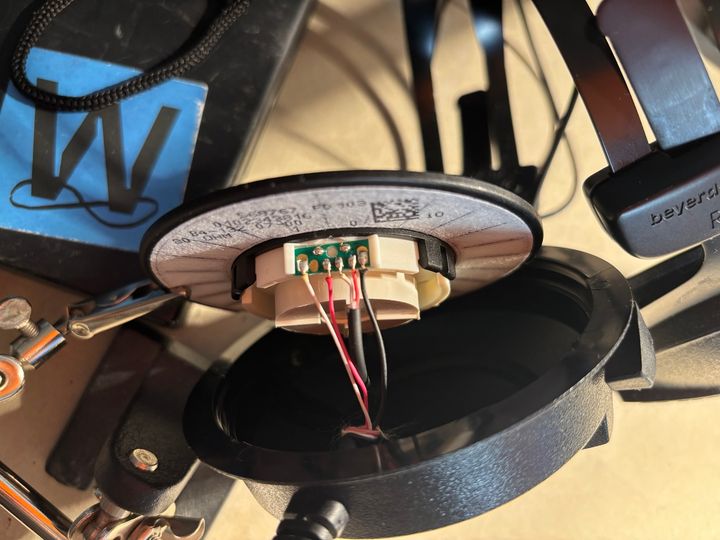
I thought soldering would be easy.
I had watched a tutorial: Heat the joint, add solder, attach the wire. Simple.
Then I tried it.
One driver in my old beyerdynamic DT 770 PRO headphones had died. They are my default headphones, and beyerdynamic sells replacement parts, so instead of replacing the headphones I ordered a new driver and tried to fix them myself.
It was my first time soldering. Even with a helping-hands tool I somehow never had enough hands. I sweated over tiny wires. It took forever. My solder joints looked nothing like the tutorial.
There is a useful term for what happened to my confidence: the “beginner’s bubble”. A little knowledge can make beginners rapidly more confident before experience exposes how much skill the task actually requires.1 Humbling.
Eventually, sound came back.
The headphones worked again because they had been designed to be repaired.
The DT 770 PRO dates back to 1985. beyerdynamic still sells individual components and describes longevity and replaceability as part of its product philosophy.2
That should be normal.
It isn’t.
Right to Repair turns the same idea into policy: when something fails, repair should remain a realistic option. The EU now has a specific repair directive, while Switzerland has repairability and spare-parts requirements for specified product categories.3
Apple is an interesting contrast precisely because I like its products. Genuine parts, tools and manuals became available to qualifying independent repairers in 2019 and to consumers through Self Service Repair in 2022. Apple has expanded those options since.4
Those are good changes. But whether I can repair something I own should not depend only on whether a manufacturer chooses to allow it.
The point is not that everyone should repair everything themselves. Often I will happily pay someone who knows what they are doing.
The point is that the choice should remain mine.
And “doing it myself” was not really doing it alone. I needed a spare part, a tutorial, tools and a place to work. Marco let me use his workbench at Warmbächli. Thanks, Marco!
My DT 770s are working again. Not quite at 100%. My dirty solder job may be the reason, so I will probably have to open them once more.
That does not make the repair a failure. It means I still have the choice to keep working on something I own.
A product should not stop being mine the moment it breaks. If I bought it, I should be free to open it, repair it, choose who repairs it, and keep it alive. Repairability is not a feature. It is part of ownership.
-
Carmen Sanchez and David Dunning, “Overconfidence among beginners: Is a little learning a dangerous thing?”, Journal of Personality and Social Psychology 114(1), 2018, pp. 10–28. Across six studies, they describe a “beginner’s bubble” in which initial learning can produce overconfidence before further experience improves calibration.
-
beyerdynamic, “A portrait of the DT 770 PRO”, 1 April 2024, dates the model to 1985 and describes replaceable parts as a way to preserve long-term functionality. Current company material also describes longevity as part of its product philosophy.
-
European Commission, Directive on repair of goods, on Directive (EU) 2024/1799, and the Swiss Federal Office for the Environment, Circular economy, on Swiss ecodesign and repairability requirements. Both frameworks are product-scoped; neither establishes a universal legal right covering every object.
-
Apple, “Apple offers customers even more options for safe, reliable repairs”, 29 August 2019; “Apple’s Self Service Repair now available”, 27 April 2022; and “Apple to expand repair options with support for used genuine parts”, 11 April 2024. Together they document the expansion from qualifying independent repair businesses to consumer self-service and later broader parts options.